Quick Links to Specific Definitions
Potential Solver Methods
The simulator uses potentials of the form
Φtotal = Φbg+ Φsg
to derive the force on the particles, where Φbg is
an imposed background potential and Φsg is the
potential due to the self-gravity of the particles. Self-gravity can be
turned on or off (as can the background potential) and integrated by
selecting the desired potential solver method.
No Self Gravity: This option turns off self-gravity so particle motion may be
evaluated using only a background potential.
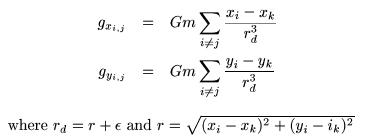
Direct Force Summation: This method finds the acceleration on each particle directly by
adding up the accelerations due to all the other particles individually
according to
Potential Types
The force, and therefore the acceleration, experienced by a
particle is derived from the potential field in which the particle
resides: F = -∇Φ.
The simulator provides many models for the background potential.
No Background Potential: This option turns off the background potential so that particle
trajectories may be evolved using only self-gravity.
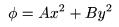
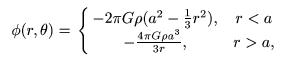
Power Law Potential: The simulator uses a power law potential of the form
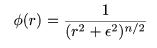 ,
,

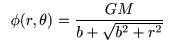
Integration Methods
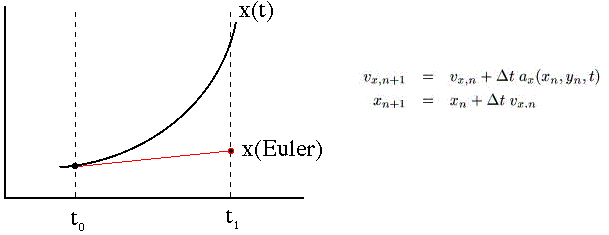
Finding each particle's position and velocity for each timestep requires
knowing the particle's acceleration and initial conditions for that
timestep. The acceleration is determined using the potential at each
location according to
 ,
,
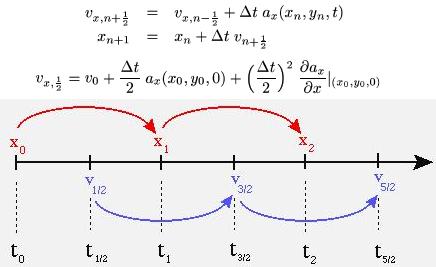
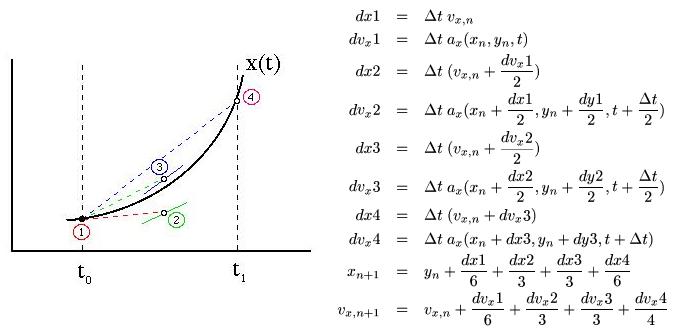
| Leapfrog Method: The Leapfrog integration method is only slightly higher in computational cost than the Euler method, but it's error term is third order. As can be seen in the diagram and formulae, this method uses the derivatives at the midpoint of each step. This only requires one additional step to be taken in order to move the velocity a half step ahead of the position. Because of its better accuracy while still keeping the simulation generation time relatively low the Leapfrog method is the default integration scheme. |
|
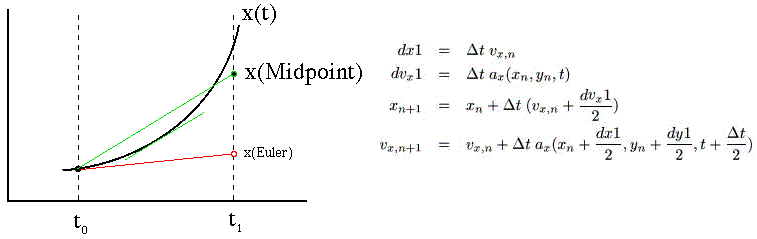
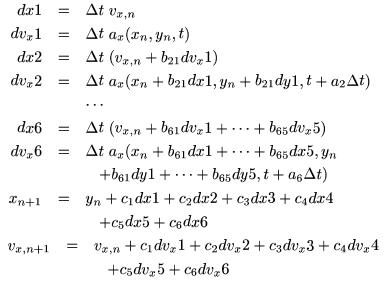
| Cash-Karp Method: The Cash-Karp method is basically the same as a fifth order Runge-Kutta scheme. It uses various constants found by Cash and Karp (see Numerical Recipes, 2nd edition) in the formulae shown. This is the most accurate integration technique available on the simulator, having a sixth order error term, but it is less practicle because of its enormously high cost in computational time. |
|
Other Simulator Parameters
Time Duration: This input gives the total time duration of the simulation.
Timestep: The timestep sets the time interval Δt used in the
integration scheme.
Image Frequency: The image frequency tells the simulator how often to
"dump" the simulation data in numbers of timesteps. Each of
these dumps is used to create a frame in the final movie, so the number of
frames that will be present is given by the time duration divided by the
product of the timestep and image frequency.
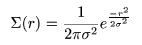
Alpha: The parameter "Alpha" is a measure of dispersion in a
Gaussian surface density distribution. The simulator uses a surface
density of the form
Students working on the simulators available in the Digital Demo Room
participate in the "Research Experience for Undergraduates", or
REU, program in the Physics Department of the University of Illinois. The
students give presentations on their projects and also write a scientific
paper. The paper for the Thin Disc Galaxy simulator, which was built by
Scott Olsson and Geert Vrijsen during the 2001 REU program, is available
here for anyone interested in seeing
the development of this pedagogical project.
Return to the simulator!